Catatonia is an important clinical syndrome that requires careful recognition and structured assessment. It can occur in association with different psychiatric and medical conditions, making awareness of its clinical presentation an important part of psychiatric practice.
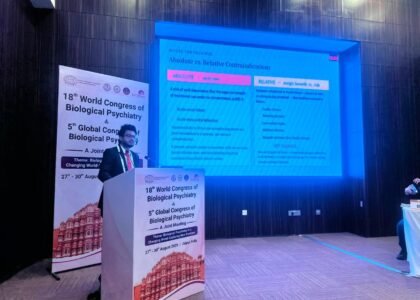
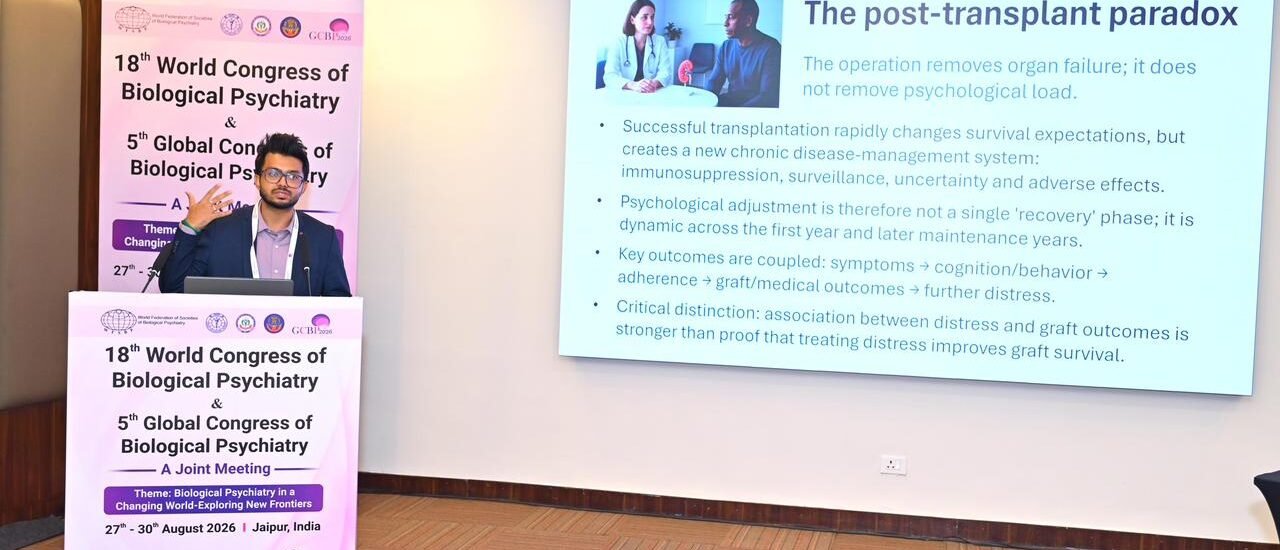
Dr. Suvayan Saha presented on “Catatonia: Recognition & Rating Scale” at the 18th World Congress of Biological Psychiatry in Jaipur. The session focused on the importance of recognising catatonia and using structured approaches to assess its severity.
Recognising catatonia begins with careful clinical observation. Changes in movement, behaviour, communication and responsiveness can form part of the clinical picture. Because these features may vary considerably between individuals, a systematic approach to assessment can help clinicians identify relevant signs more consistently.
A structured rating scale can provide additional support during clinical evaluation. Rating scales help organise observations and may assist clinicians in documenting the presence and severity of specific clinical features. They can also provide a common framework for communication among healthcare professionals and may be useful when monitoring changes over time.
However, assessment tools are not a replacement for clinical judgement. A rating scale should be considered as part of a broader clinical assessment that includes the individual’s history, symptoms, physical health, mental state and relevant medical or psychiatric factors.
The recognition of catatonia is particularly important because its presentation can sometimes be complex. A patient may show marked changes in behaviour or motor activity, and these changes may require careful evaluation to understand their clinical significance. Appropriate assessment therefore involves looking at the overall clinical picture rather than relying on a single symptom or observation.
Academic discussions on catatonia also highlight the importance of continued professional education. Psychiatric knowledge continues to develop, and opportunities to discuss clinical assessment methods with other professionals can contribute to ongoing learning.
The 18th World Congress of Biological Psychiatry provided an important platform for sharing knowledge across different areas of biological psychiatry. Presenting a topic such as catatonia recognition and rating scales allows clinicians to discuss practical aspects of assessment while reflecting on developments in psychiatric practice.
For Dr. Suvayan Saha, participation in this academic programme represents continued engagement with professional learning and contemporary psychiatric education. Such experiences provide opportunities to exchange ideas, explore clinical perspectives and remain connected with developments in the field.
Understanding catatonia requires attention to both clinical observation and structured assessment. Rating scales can support the assessment process by providing a systematic framework, while professional judgement remains central to interpreting findings within the individual’s clinical context.
Continued education, clinical discussion and evidence-informed practice can help strengthen the understanding of complex psychiatric presentations such as catatonia and contribute to thoughtful, patient-centred mental healthcare.